

The previous article followed plastic into your body. This one follows it back to where it came from.
Nobody sets out to put plastic in the sea. Yet there it is, in every ocean and on every beach, including ones nobody lives near. It did not get there by being thrown in. It got there from the bin, the drain, the road and the paddock, a little at a time, for seventy years. Below are the main roads it travels, roughly in the order the plastic itself would take them.
Plastic is shipped around the world as pellets the size of a lentil. The industry calls them nurdles. They are moved by the billion, in sacks and containers and rail wagons, and some get spilt at every step. A handful lost on a wharf here, a burst sack there, a container overboard in a storm. They are light, they float, and they never rot, so the sea ends up with a good share of them. Walk along the tide line on most beaches and you will find some. They look like fish eggs, which is what the birds take them for.[1]
Sometimes it is not a handful. In May 2021 the container ship X-Press Pearl caught fire and sank off Colombo with about 1,700 tonnes of pellets on board, something like 75 billion of them. They came ashore along the Sri Lankan coast in drifts a metre deep, and they are still turning up. It is the biggest plastic spill on record, and it was not oil, it was raw material.[2]
Factories lose them too, and not always by accident. Formosa Plastics in Texas was found to have been discharging pellets into Lavaca Bay through its wastewater outfalls for years. Local residents proved it by collecting the pellets themselves, thousands of samples, and in 2019 the company paid fifty million US dollars to settle. Nobody supposes it was the only plant doing it, just the only one that got caught by people with buckets.[3]
Pellets are not the biggest source of plastic in the sea by weight, but they are the only one that is pure, brand-new plastic going straight into the water before it has ever been used for anything.
Most plastic goes in the bin and the bin goes to landfill. That is actually one of the better outcomes. A landfill is a hole with a liner and a cap, and while the plastic in it is doing nothing useful, it is at least staying put.
The trouble is the bit that never makes it to the hole. Wrappers blow out of trucks and off the tip face. Bottles roll off the back of the ute. Bags end up in the hedge by the road. Anything that lands in a gutter is in the stormwater drain by the next rain, and the stormwater drain goes to the creek, and the creek goes to the sea. There is no filter on it.
We were told that the answer was recycling, and we all dutifully rinsed our bottles and sorted our bins. Around the world, less than a tenth of all the plastic ever made has been recycled. The rest was burnt, buried or lost.[4]
Some of what we sorted was baled up and shipped to countries that had said they would recycle it. A lot of that was dumped or burnt in the open once it arrived, because it was cheaper than sorting it. When those countries stopped taking it, the bales piled up here instead. And the plastic that does get recycled can only go round once or twice before it is too degraded to use, at which point it goes in the bin like everything else.
The thin supermarket bag was banned as a single-use bag. It never was one. Most people used it two or three times, and then it lined the kitchen bin. When the UK Environment Agency looked at it, three quarters of the bags were being reused and four in ten ended up as bin liners. It weighed a few grams, and it was about the least plastic you could carry your shopping home in.
Its replacement is a heavy woven plastic bag that weighs ten times as much. The same study worked out it has to be used fourteen times just to break even with the thin bag, and twenty-six times if the thin bag was going to line the bin anyway. A cotton bag has to be used well over a hundred times.[5]
They do not get used that many times. Everybody has a cupboard full of them, because you never have one with you when you need one, so you buy another. They get soiled : a leaking takeaway, a bit of raw meat, a dripping milk bottle, and it goes in the bin rather than the wash. So the heavy bags get thrown away too, at much the same rate, and every one of them is a great deal more plastic than the bag it replaced.
Look at the label on your clothes. Polyester, nylon, acrylic, elastane : all plastic. Every wash shakes fibres loose from them, and they are far too fine for the washing machine filter or the sewage treatment plant to catch. A single load of fleece sheds hundreds of thousands of them. They go down the drain, through the treatment plant, and out to the river or the sea, where they are now the most common kind of plastic found.[6]
The dryer does the same thing, but into the air instead of the water. The fluff in the lint trap is the coarse end of it. The fine end went out the vent.
A car tyre starts its life with about a kilogram and a half of tread on it and ends with none. It did not evaporate. It was ground off onto the road, a few grams every hundred kilometres, and rain washed it into the drain. Multiply that by every vehicle in the country and tyre dust turns out to be one of the biggest sources of plastic in the environment there is, bigger than litter. Nobody sorts it, nobody recycles it, and an electric car, being heavier, makes more of it, not less.[7]
Road markings and the bitumen itself are partly plastic too, and they wear the same way.
The sewage treatment plant catches a fair bit of what comes down the drain, and what it catches ends up in the sludge. The sludge is dried, called biosolids, and spread on farmland as fertiliser. So the plastic from your washing machine, your bathroom and your kitchen sink gets a second life on a paddock, where it is ploughed into the soil the food is grown in. Farmland in Europe has been measured as holding more plastic than the surface of the oceans.[8]
Farms add their own on top : silage wrap, bale netting, mulch film, tree guards, irrigation pipe and drip tape, all left in the sun until they go brittle and break up.
This one surprises people. Nearly all modern paint is acrylic, which is a plastic dissolved in water. When the water dries off, a thin sheet of plastic is left on the wall, the roof, the fence, the road marking or the hull of the ship. Then the weather gets to work on it. It chalks, it flakes, it gets sanded off and water-blasted off, and all of that goes to the ground and the drain. Some estimates put paint at the top of the list of sources of microplastic in the sea, above tyres and above textiles.[9]
Everything above ends up here, but the sea has one big source of its own : fishing gear. Nets, lines, ropes, floats and crates, all plastic, all lost or dumped at sea. A lost net does not stop fishing. It drifts and keeps catching for years, which is why they are called ghost nets. Then it breaks up and joins the rest.
Once in the sea, sunlight and waves grind everything down to the size of plankton, and it gets eaten by the things that eat plankton. From there it works its way up to the fish on your plate. Which is where the previous article started.
Plastic gets into the environment because it is built to last and treated as if it does not. The obvious route, litter, is not the big one. The big ones are the ones nobody sees : tyre dust, washing machine fibres, paint, and sewage sludge spread on farmland. Recycling has done far less than we were told. Whatever was not burnt is still out there, in ever smaller pieces. What those pieces do once they are there is the subject of the next article.
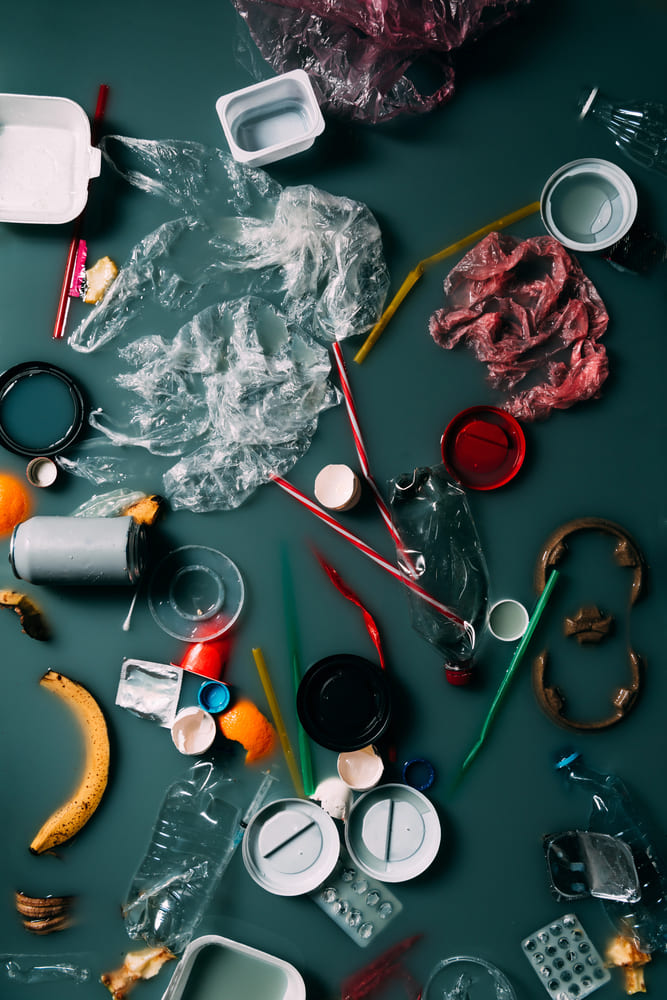 Trash and leftovers floating in the water - deposit